
The short version: Most Canadian senior care facilities are mid-journey from paper to digital — and AI is arriving before the journey is finished. Here’s the upgrade path we’re seeing in 2026, and the infrastructure each stage demands.
Stage 1: Paper and binders (where many started)
Not long ago, the standard toolkit was a clipboard, a binder of care plans, a whiteboard for the shift schedule, and a fax machine. It worked — until it didn’t: illegible notes, lost pages, no audit trail, and information trapped in one person’s head.
Stage 2: Basic digital (where most facilities are now)
The first wave of upgrades is familiar:
- Digital care plans and electronic charting replacing binders
- Staff scheduling software replacing the whiteboard
- Email and shared drives replacing hallway conversations
- Basic Wi-Fi — usually installed for the front office, then stretched to cover the building
This stage delivers real wins — and the trap we see most often: a network designed for office work now expected to carry care-critical systems.
Stage 3: Connected care (where the leaders are)
The facilities pulling ahead in 2026 are layering connected systems on top of digital foundations:
- Networked nurse-call and wander-management systems
- Smart door access — keyless entry for staff, secure perimeters for memory-care wings
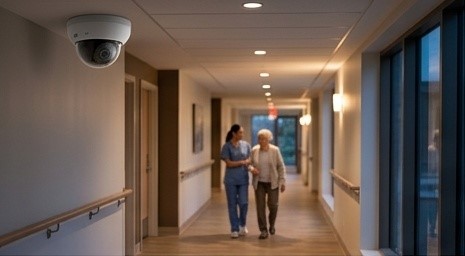
- CCTV and video monitoring in common areas, increasingly with AI-assisted review
- Staff devices everywhere — tablets and phones as the primary charting tool, so Wi-Fi must work in every room, not just near the nursing station
Each is a network load and a security surface, and each assumes the Stage 2 infrastructure was done properly. Often, it wasn’t.
Stage 4: AI-assisted care (what’s arriving now)
The newest wave is genuinely different — systems that watch, predict, and alert:
- AI fall detection — vision or radar sensors that recognize a fall and alert staff in seconds. Falls cause 89% of injury-related hospitalizations among Canadian seniors, and 20–30% of older adults fall each year — this is the highest-value AI application in senior care right now.
- Predictive fall-risk analytics — gait monitoring that flags rising risk before the fall happens.
- Smart medication dispensers — synced to care records.
- Ambient health monitoring — contactless sensors tracking sleep and respiration overnight.
Canadian business AI use doubled in a single year — 6.1% to 12.2% (StatCan, Q2 2025) — and healthcare is riding the same curve. Facilities adopting these systems in 2026 aren’t experimenting; they’re responding to staffing and demographic pressure every operator feels.
The upgrade path that actually works
Our advice: a phased approach — network first, devices second:
- Assess honestly. A real site survey: heat-mapped Wi-Fi coverage, switch and cabling inventory, single points of failure. You can’t plan the upgrade until you know what you have.
- Fix the foundation. Business-grade managed switches, engineered access-point placement, VLAN segmentation, PoE with battery backup, dual-WAN failover. Unglamorous work — pulling cable, configuring switches, testing failover — that everything else depends on.
- Pilot one system. Pick one AI or connected system, deploy it on one floor or wing, and measure. Fall detection is usually the best first pilot: clear ROI, clear safety impact.
- Train the staff. The best sensor system fails if staff don’t trust the alerts or know the escalation workflow. Adoption is a people project too.
- Monitor everything. 24/7 monitoring of every connected device, with alerts that reach a human in minutes. An offline sensor is a gap in care — treat it like one.
The mistakes that stall upgrades
- Buying devices before fixing the network. The most expensive mistake. A $150 consumer router cannot run a building full of always-on care devices.
- Skipping segmentation. Care devices, staff laptops, and resident streaming on one flat network is a security incident waiting for a date.
- No power resilience. Sensors with batteries, fed by switches without them. First outage, the floor goes dark.
- Vendor promises, no verification. “Works with your existing Wi-Fi” is a claim, not a site survey. Verify before you sign.
References & Data
- Statistics Canada — Canadian Survey on Business Conditions, Q2 2025: business AI use 12.2%, up from 6.1% a year earlier; 14.5% plan adoption within 12 months.
- Public Health Agency of Canada — falls cause 89% of injury-related hospitalizations among older adults; 20–30% of older adults fall each year; ~$5.6B/year in direct healthcare costs (2018 dollars).
- Canadian Institute for Health Information (CIHI) — injury and trauma statistics, July 2026: ~291,000 injury hospitalizations in 2024–2025; 6% increase in ages 65–84 driven by falls.
Wherever you are on the journey, start with the network
Whether you’re still on binders or piloting AI sensors, the next step is the same: make sure your infrastructure can carry where you’re going. After 15+ years building networks for hospitality and care environments across the GTA — including 250+ camera security deployments — the lesson never changes: engineer the network first, and every system on top of it works as promised.
IT Like Life offers hands-on IT consulting, network infrastructure design, web development, and 24/7 tech support for senior living facilities, hospitality, and small businesses across the Greater Toronto Area.
Call 647-500-3381 — 24/7 support, ~30-minute average response. itlikelife.com