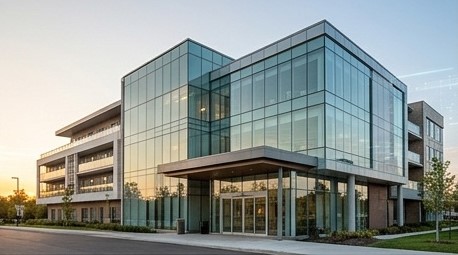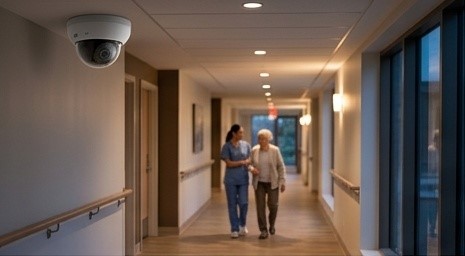
The short version: Hotels figured out always-on, high-density networks years ago — hundreds of guests streaming at once, keyless entry that can’t fail, property management systems that can’t go down at check-in. Retirement residences now need that same reliability for fall sensors, wearables, and smart dispensers. Here are five hospitality lessons for senior care.
What a hotel network actually has to survive
- 200+ rooms, each with three to five devices streaming at once — plus staff devices and IoT: door locks, thermostats, cameras, digital signage.
- Property management system (PMS) uptime. Check-in, billing, room assignment — downtime at the 3 p.m. rush is a revenue disaster.
- Keyless entry that must work even when the internet doesn’t. A guest locked out of their room is a one-star review in real time.
- Camera systems streaming continuously — hundreds of cameras across lobbies, corridors, and perimeters.
Hotels learned, often painfully, that the guest experience is an infrastructure product. Senior living is learning the same lesson now — except the stakes are resident safety, not review scores.
Five hospitality lessons for senior care
- Design for density, not coverage. A signal bar in the hallway means nothing when forty devices connect in one wing. Hotels engineer for hundreds of concurrent clients per floor — a residence floor full of sensors, wearables, and staff tablets is the same math. Count the devices, then design.
- Segment everything. Hotels isolate guest Wi-Fi, staff systems, IoT devices, the PMS, and cameras. The senior-care translation is direct: care devices, staff systems, resident/family Wi-Fi, and building systems each get their own VLAN.
- Monitor like it matters — because it does. Hotels use proactive monitoring: an access point going dark pages someone before guests notice. Residences need the same discipline — a fall sensor that dies at midnight must alert staff at midnight, not in Friday’s incident report.
- Power is part of the network. Hotel door locks carry local battery fallback; network closets sit on UPS. Same for care: PoE switches on battery backup keep sensors, cameras, and access points alive through every flicker.
- Plan for the peak, not the average. Hotels design for the check-in rush and the 9 p.m. streaming peak. Residences have their own: shift change, the evening medication pass, family video-call hour. If the network only holds up at 3 a.m., it doesn’t hold up.
The direct translation: hotel system → residence system
- PMS uptime → eMAR and medication system uptime
- Keyless door locks → smart door locks and wander-management systems
- Guest Wi-Fi → resident and family Wi-Fi (video calls with grandkids are a quality-of-life issue)
- CCTV networks → fall-detection cameras and ambient sensors
- Front-desk phones → nurse-call systems
Different labels, identical requirements: segmented, monitored, powered, and redundant.
Where residences typically start — and what hotels learned the hard way
The starting point is familiar: a consumer-grade router in the office, one flat network for everything, Wi-Fi that “works in the hallway,” and no monitoring whatsoever. Hotels made every one of these mistakes a decade ago and paid for it in outages, breaches, and bad reviews. The fix is equally familiar: engineered Wi-Fi, VLAN segmentation, dual-WAN failover, battery backup in every closet, and 24/7 monitoring with real alerting.
From the field
Hospitality work teaches you to think in worst cases: designing Wi-Fi for a property where every room streams at once, segmenting camera traffic so video streams can’t crowd out the property management system, and building 250+ camera deployments on networks engineered for the load before a single camera was mounted. That same worst-case thinking is what senior care needs now — engineer the network first, and every system layered on top performs the way the brochure promised.
The demand curve
- 1 in 5 Canadians is now 65 or older (20.0% as of July 1, 2026, StatCan preliminary estimates; Ontario at 19.5%).
- The 85+ population grows rapidly between 2031 and 2050, and Canadian business AI use doubled in a single year (6.1% to 12.2%, StatCan). More seniors, more sensors, more AI — all riding on the building’s network.
References & Data
- Statistics Canada, preliminary population estimates (July 1, 2026): 1 in 5 Canadians (20.0%) aged 65+; Ontario 19.5%. Canada classified as a “super-aged” society.
- Statistics Canada, Population Projections for Canada (2025–2075): population aged 85+ grows rapidly between 2031 and 2050.
- Statistics Canada, Canadian Survey on Business Conditions, Q2 2025: 12.2% of businesses used AI to produce goods or deliver services, up from 6.1% a year earlier.
Build your residence network like a hotel — before you need it to be one
Fall sensors, wearables, smart locks, and medication systems are only as reliable as the infrastructure underneath them. If your Wi-Fi was designed for email, your devices share one flat network, or outages surface through complaints — that’s the upgrade to make now.
IT Like Life provides hands-on IT consulting, network infrastructure design, web development, and 24/7 tech support for senior living, hospitality, and small businesses across the Greater Toronto Area. Fifteen-plus years engineering networks that don’t go down — including 250+ camera security deployments built on infrastructure designed first.
Call 647-500-3381 — 24/7 support, ~30-minute average response. itlikelife.com