
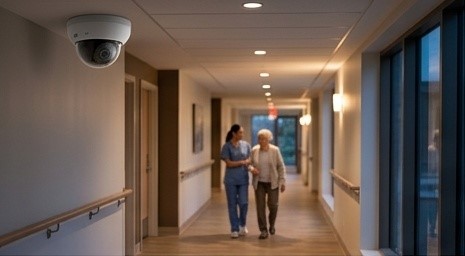
The short version: AI fall detection is one of the fastest-moving upgrades in Canadian senior care. But the cameras, sensors, and wearables are only half the system — they all run on your building’s network. Here’s what the technology needs, what most facilities get wrong, and how to get it right.
The numbers behind the urgency
- Falls cause 89% of injury-related hospitalizations among Canadian seniors — 34% of those involve a hip fracture (Public Health Agency of Canada).
- Falls among Canadians 65+ cost an estimated $5.6 billion a year in direct healthcare costs (2018 dollars).
- 20–30% of older adults in Canada experience a fall each year.
- Canada is now officially “super-aged”: 1 in 5 Canadians is 65 or older, and the 85+ population will grow rapidly between 2031 and 2050 as baby boomers age into it.
- Hospitalizations for fall injuries are still rising: CIHI recorded a 6% increase in the 65–84 group in a single year, driven by falls.
Every minute between a fall and a response changes the outcome. That’s exactly the gap AI fall detection closes — and exactly where IT infrastructure decides whether the system works or fails silently.
How AI fall detection actually works
Modern systems fall into four categories:
- Vision-based detection — ceiling or wall-mounted cameras with on-device AI that recognizes a fall posture and alerts staff. No video needs to leave the room if configured for edge processing.
- Radar/mmWave sensors — contactless sensors that detect body movement and falls through walls and bedding, with no cameras at all. Privacy-friendly, and increasingly popular in resident rooms.
- Wearable accelerometers — smart pendants or watches that detect sudden acceleration patterns. Depend on Bluetooth or Wi-Fi gateways in every corridor.
- Acoustic/ambient sensors — microphones paired with AI that recognize the sound signature of a fall. Rare alone, usually layered with one of the above.
What they share: every one of them is a networked device. Every one fails the same way when the network fails — quietly, in a hallway, at 2 a.m.
The infrastructure behind the AI: what the sales brochures skip
Vendors sell sensors. They don’t sell you the network those sensors live on. Here’s what AI safety systems actually require:
Ubiquitous, engineered Wi-Fi coverage
- Heat-mapped coverage in every resident room, bathroom, stairwell, and courtyard — not just hallways.
- Fall-detection sensors roam constantly; a dead zone in one bathroom defeats the entire system.
- Dedicated SSID for care devices, separated from resident and guest traffic.
Segmented, secure networks
- IoT and care devices on their own VLAN, firewalled from admin systems and the public internet.
- Resident health data in motion is protected health information — design the network like it matters, because legally it does.
Power and uptime that never blink
- PoE switches with battery backup so sensors stay alive through outages.
- Dual-WAN failover: if your single internet line drops, every alert stops. Redundancy isn’t optional when seconds count.
Low latency for edge processing, real bandwidth for cloud
- Edge-AI sensors need only milliseconds of local latency — but they must stay connected.
- Cloud-based analytics need sustained upstream bandwidth. Verify yours before signing the vendor contract.
Monitoring you can actually see
- 24/7 network monitoring with instant alerts when a sensor goes offline — not a weekly report.
- If you learn a fall sensor was offline from a family member instead of your dashboard, the system has already failed.
Where most facilities get it wrong
The same five problems show up again and again:
- Consumer-grade routers running a care facility. A $150 router cannot handle 200+ always-on devices. Replacing these with business-grade managed switches and access points is the single most common fix we make.
- No network segmentation. Fall sensors, staff laptops, resident streaming, and door-access all on one flat network. One compromised device, everything exposed.
- Wi-Fi designed for hallways, not rooms. Site surveys done by walking the corridor with a phone. Bathrooms and stairwells — where falls actually happen — left as dead zones.
- No power backup on network gear. The sensors have batteries. The switch feeding them doesn’t. First power flicker, the whole floor goes dark.
- Nobody watching the watchers. No monitoring, no alerting. A sensor dies on Tuesday; nobody knows until the incident report on Friday.
From the field: what getting it right looks like
When we harden a facility’s network, the work is unglamorous and decisive: pulling proper Cat6 runs to ceiling-mounted access points, configuring VLANs that isolate care devices from guest traffic, setting up dual-WAN failover with automatic switchover, and putting every network closet on battery backup.
Hospitality taught us the same lesson senior care is learning now. In hotels — hundreds of guests streaming, keyless entry, property management systems that can’t go down at check-in — the entire guest experience runs on infrastructure nobody sees. A 250-camera security deployment across a property only works if the network underneath it was engineered first, not decorated afterward. Retirement residences are arriving at the same conclusion, one incident report at a time.
The pattern is consistent: money spent on the network first makes every device layered on top of it — AI cameras, wearables, automated medication dispensers, smart door locks — perform the way the brochure promised.
What’s next: AI in Canadian senior care, 2026 and beyond
- Predictive fall-risk scoring. AI moving from detecting falls to predicting them — gait analysis from hallway sensors flagging residents whose fall risk is rising week over week.
- Medication adherence automation. Smart dispensers synced to care records, cutting one of the most common sources of adverse events in senior living.
- Ambient health monitoring. mmWave radar tracking respiration and sleep patterns overnight — no wearables, no cameras, continuous data.
- The adoption curve is steepening. Canadian business AI use doubled in a single year (6.1% to 12.2%, per StatCan). Healthcare and senior living are following the same curve, roughly 12–18 months behind the leading sectors.
The facilities that get ahead won’t be the ones with the most sensors. They’ll be the ones whose networks were ready before the sensors arrived.
References & Data
- Statistics Canada, Population Projections for Canada (2025–2075) — share of Canadians aged 65+ rises from 19.5% in 2025; population aged 85+ grows rapidly 2031–2050.
- Statistics Canada preliminary estimates, July 1, 2026 — 1 in 5 Canadians (20.0%) now aged 65+; Ontario at 19.5%. Canada classified as a “super-aged” society.
- Statistics Canada, Canadian Survey on Business Conditions, Q2 2025 — 12.2% of businesses used AI to produce goods or deliver services, up from 6.1% a year earlier; 14.5% plan adoption within 12 months. Information and cultural industries lead at 35.6%.
- KPMG Canada (2025) — 51% of Canadian employees now use generative AI, up from 46% a year earlier.
- Benefits and Pensions Monitor, September 2026 — 58% of Canadian employers have approved AI tools for work.
- Canadian Institute for Health Information, July 2026 — ~291,000 injury hospitalizations in 2024–2025; falls remain the leading cause; 6% increase in the 65–84 age group driven by falls.
- Public Health Agency of Canada — falls cause 89% of injury-related hospitalizations among older adults; 34% involve a hip fracture; ~$5.6B/year in direct healthcare costs (2018 dollars); 20–30% of older adults fall each year.
Is your facility’s network ready for AI?
AI fall detection, smart wearables, and automated medication systems are only as reliable as the infrastructure underneath them. If your Wi-Fi has dead zones, your devices share one flat network, or you hear about outages from staff instead of your monitoring dashboard — that’s the fix that comes before the AI.
IT Like Life provides hands-on IT consulting, network infrastructure design, web development, and 24/7 tech support for senior living facilities, hospitality, and small businesses across the Greater Toronto Area. We engineer the network first, so your technology performs the way it was promised.
Call 647-500-3381 — 24/7 support, ~30-minute average response. itlikelife.com