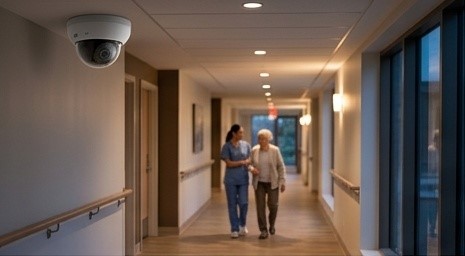
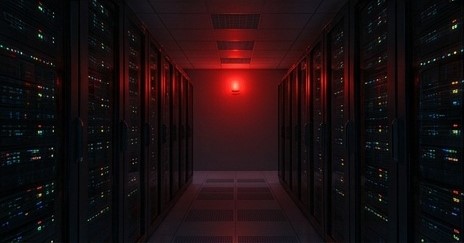
The short version: When a retirement home’s network drops, it isn’t an IT inconvenience — fall-detection sensors stop reporting, door access freezes, nurse-call tablets lose their connection, and medication records go dark. Here’s what an outage really costs a Canadian senior care facility, the failures we see most often, and the five-layer playbook that prevents them.
What actually goes down when the network goes down
Modern retirement homes run on their networks the way hospitals run on oxygen lines. A single outage can take out:
- AI fall-detection sensors and wearables — the devices stop reporting. Staff see a dashboard that says “all clear” because nothing is arriving. Silence reads as safety; it isn’t.
- Nurse-call and wandering-management systems — tablets and pendants lose their link to the response station.
- Electronic medication records — eMAR carts can’t verify doses against resident profiles.
- Door access and security cameras — keyless entry freezes, and the camera feed goes black.
- Staff communication — VoIP phones and messaging apps die together.
- Family-facing systems — visitor sign-in, digital care updates, and billing portals all go dark at once.
None of this is hypothetical. In a mid-size residence, a network outage at 2 a.m. means dozens of networked safety devices blinking offline while a skeleton crew covers multiple floors.
The real cost, beyond the IT ticket
- Life-safety risk. A fall sensor that can’t send an alert is a fall sensor that doesn’t exist. Falls cause 89% of injury-related hospitalizations among Canadian seniors, and 20–30% of older adults fall each year — the window between a fall and a response is exactly where outcomes are decided.
- Operational chaos. Staff revert to paper, rounds take twice as long, and the incident reporting you need for compliance gets scribbled on whatever is at hand.
- Regulatory exposure. Canadian retirement homes and long-term care facilities answer to provincial regulators. Gaps in medication records or missed wandering alerts during an outage become findings in an inspection.
- Family trust. One review — “my mother’s fall alert didn’t work” — undoes years of reputation. In a super-aged country where 1 in 5 Canadians is 65 or older, families choose residences on exactly this kind of reliability.
- Vendor finger-pointing. The sensor vendor blames the ISP, the ISP blames the router, and nobody owns the problem until you force them to.
The causes we see again and again
- One internet connection, no failover. A single ISP line is a single point of failure for every safety system in the building.
- Consumer-grade gear under commercial load. A home router and two bargain access points trying to serve 200+ always-on devices. It doesn’t fail gracefully — it fails at the worst possible moment.
- No power backup on network equipment. The sensors have batteries. The PoE switch feeding them doesn’t. First brownout, the whole floor goes dark.
- No monitoring. Nobody knows the WAN dropped until a staff member notices the cameras are frozen. The outage started an hour ago.
- No documented failover plan. Staff don’t know what to do when systems go dark because nobody ever wrote it down or tested it.
The five-layer prevention playbook
- Business-grade wired backbone. Proper Cat6 (or 6a) runs to every access point, camera, and network closet. Wi-Fi is only as good as the wire behind it.
- Segmented networks. Care devices on their own VLAN, firewalled from resident Wi-Fi, admin systems, and the public internet. An outage on the guest network should never touch a fall sensor.
- Power redundancy. Every network closet on battery backup with automatic switchover. Size it so the core network rides through a multi-hour outage — not fifteen minutes.
- Dual-WAN failover. Two independent internet connections (different carriers, ideally different technologies) with automatic failover. Test the switchover quarterly. If you’ve never tested it, you don’t have it.
- 24/7 monitoring with real alerts. Every switch, access point, and gateway monitored around the clock, with instant alerts to someone who can act. Our own standard is a ~30-minute average response — because an alert at 2 a.m. is worthless if nobody moves until 9.
From the field
The most satisfying jobs are the boring ones: walking into a facility after its third outage in two months, finding a single overloaded router and daisy-chained switches in a dusty closet, and replacing the whole mess with a properly designed network — managed switches, heat-mapped Wi-Fi, segmented VLANs, dual-WAN, and monitoring that actually reaches a human. The outages stop. Not because the technology is exotic, but because the basics were finally done right.
We apply the same discipline in hotels, where a network outage at check-in hits revenue in minutes. The lesson transfers directly: engineer the infrastructure first, monitor it always, and never let a single device be a single point of failure.
References & Data
- Public Health Agency of Canada: falls cause 89% of injury-related hospitalizations among older adults; 34% involve a hip fracture; ~$5.6B/year in direct healthcare costs (2018 dollars); 20–30% of older adults fall each year.
- Canadian Institute for Health Information (CIHI), July 2026: ~291,000 injury hospitalizations in 2024–2025; falls remain the leading cause; 6% increase in the 65–84 age group driven by falls.
- Statistics Canada preliminary estimates (July 1, 2026): 1 in 5 Canadians (20.0%) now aged 65+; Ontario at 19.5%. Canada classified as a “super-aged” society.
The cheapest outage is the one that never happens
A retirement home’s network isn’t office infrastructure — it’s life-safety infrastructure. If your facility runs on a single ISP, consumer-grade gear, or a network nobody monitors overnight, you’re one outage away from a very bad incident report.
IT Like Life provides hands-on IT consulting, network infrastructure design, web development, and 24/7 tech support for senior living facilities, hospitality, and small businesses across the Greater Toronto Area. We engineer the network first, so your safety systems work when they matter most.
Call 647-500-3381 — 24/7 support, ~30-minute average response. itlikelife.com